5 Benefits of Using a Portable Battery Vacuum Lifter on Construction Sites
Construction sites across Australia handle heavy, bulky materials every day. Discover 5 key benefits of portable battery vacuum lifters, from improved worker safety to job site mobility.
Construction sites across Australia handle heavy, bulky and often difficult-to-position materials every day. From steel sheets and building panels to other compatible flat materials, moving these loads safely and efficiently is essential for maintaining productivity and reducing manual handling risks.
Traditional lifting methods may require several workers, additional equipment or considerable preparation. A portable battery vacuum lifter offers an alternative by using vacuum suction to grip suitable materials and assist with controlled lifting and placement.
Unlike equipment that relies on a permanent compressed-air connection or external power supply during operation, a battery-powered vacuum lifter can offer greater flexibility in suitable applications. This is particularly useful on construction sites where work areas change and access to services may be limited.
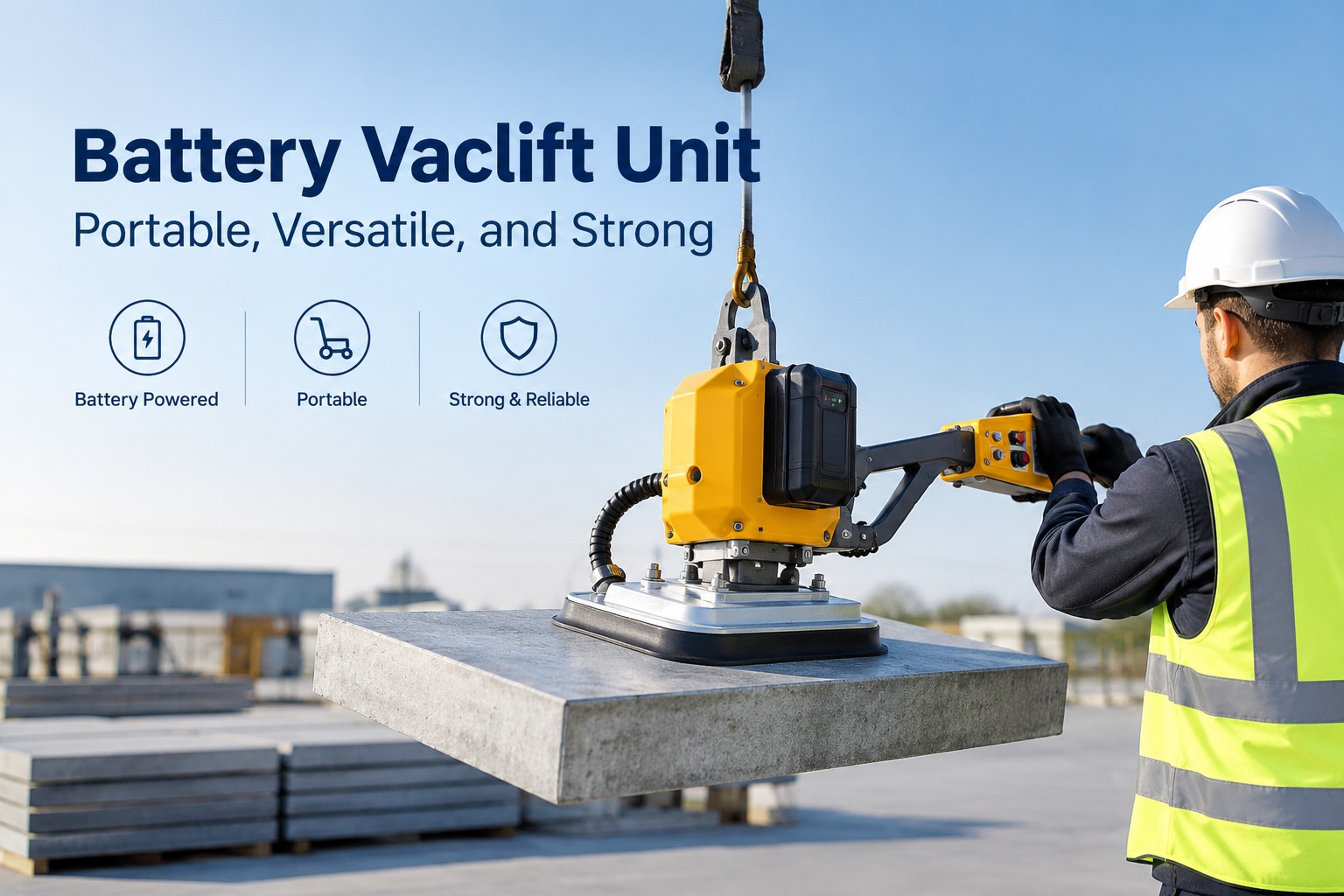
For Australian builders, contractors and construction managers, selecting appropriate lifting equipment can help improve workflow while supporting workplace health and safety practices. Vaclift Australia offers a battery-powered vacuum lifting unit designed for applications including on-site construction, steel handling and panel handling.
In this guide, we explore five key benefits of portable battery vacuum lifters, how they can support construction projects, and what to consider before choosing the right equipment.
What Is a Portable Battery Vacuum Lifter?
A portable battery vacuum lifter is a material-handling device that uses vacuum suction to grip compatible surfaces and assist with lifting, moving and positioning loads.
The equipment uses a vacuum system and suction pads to establish a grip on a suitable material. Depending on the model, the unit may be used with compatible lifting machinery, such as a crane or other approved lifting arrangement.
Battery-powered models are particularly useful when a suitable external power or compressed-air connection is unavailable or inconvenient.
Typical applications may include:
- Handling compatible steel sheets and plates.
- Moving suitable flat construction panels.
- Loading and unloading materials.
- Positioning materials during installation.
- Handling materials in construction yards and workshops.
Important: Not every vacuum lifter can handle every material. Surface texture, porosity, dimensions, load weight, centre of gravity and equipment configuration all affect suitability. Always confirm compatibility and rated capacity with the manufacturer before lifting.
5 Benefits of Using a Portable Battery Vacuum Lifter on Construction Sites
1. Improved Construction Site Safety and Reduced Manual Handling
One of the main benefits of a portable battery vacuum lifter is its potential to reduce workers’ direct involvement in manually handling suitable heavy or awkward materials.
Construction workers may need to lift, carry, hold or reposition materials repeatedly throughout a shift. These activities can involve forceful movements, awkward postures and repetitive exertion, increasing the risk of musculoskeletal injuries.
Mechanical lifting equipment can help reduce the physical effort required for appropriate tasks.
A battery-powered vacuum lifter can assist by gripping compatible materials, allowing suitable lifting machinery to move them into position rather than relying on workers to carry or hold the entire load manually.
Potential benefits include:
- Reduced reliance on manual lifting for suitable materials.
- Less physical effort during repeated handling tasks.
- Improved control during planned lifting and placement.
- Reduced need for workers to hold materials in awkward positions.
- Better opportunities to establish consistent material-handling procedures.
For Australian construction businesses, these benefits can support a broader workplace health and safety strategy. SafeWork NSW recommends assessing manual-handling risks and using mechanical methods where appropriate to reduce the need for workers to handle heavy materials manually.
However, vacuum lifting does not eliminate every hazard. Suspended loads, moving machinery, pinch points and equipment failure remain important risks. Site-specific risk assessments, exclusion zones, suitable training and correct operating procedures are still necessary.
2. Greater Flexibility Across Different Construction Sites
Construction sites rarely offer identical working conditions. A contractor may work on a commercial building project one week and a renovation, fabrication or industrial installation project the next.
Equipment that depends on fixed infrastructure can be inconvenient when work areas change or suitable power and compressed-air connections are unavailable.
A portable battery vacuum lifter can offer greater flexibility because its operation does not necessarily depend on a permanent external power or compressed-air connection.
This can be useful for:
- Construction sites with changing work areas.
- Material-handling tasks away from workshop facilities.
- Projects with limited access to external utilities.
- Suitable loading and unloading activities.
- Contractors who move equipment between multiple locations.
The actual level of portability depends on the unit's weight, lifting configuration, battery capacity, charging requirements and transport arrangements. The lifting machine or attachment required to support the load must also be suitable for the task.
Before selecting equipment, contractors should consider the entire lifting setup rather than the vacuum unit alone. The carrier, attachment points, lifting accessories and material must all be compatible with the proposed operation.
For Australian projects where site conditions change frequently, this flexibility may make battery-powered vacuum lifting equipment a practical option for suitable applications.
3. Improved Productivity and Material-Handling Efficiency
Construction schedules depend on coordinating materials, equipment and workers. When materials take longer than expected to unload, reposition or align, the delay can affect other activities on site.
A suitable vacuum lifter can streamline material handling by providing a repeatable method for gripping and moving compatible loads.
Instead of repeatedly organising manual handling for each movement, a planned lifting process can help teams manage material transfers more consistently.
Potential productivity benefits include:
- More organised material loading and unloading.
- Reduced manual repositioning where mechanical handling is suitable.
- More consistent movement of compatible materials.
- Improved coordination between equipment operators and ground workers.
- Less time spent arranging manual handling for suitable repetitive tasks.
For example, a construction contractor handling compatible flat steel sheets may need to transfer materials from a delivery area to a designated installation or storage area. With suitable lifting equipment, the team can establish a planned process for picking up, transporting and placing each sheet.
Actual time savings depend on the material, site layout, operator experience, equipment capacity and lifting method. A vacuum lifter should not be assumed to make every task faster; the right configuration and a well-planned workflow are essential.
To assess productivity improvements, contractors can compare handling times, labour requirements, equipment utilisation and delays before and after introducing the equipment.
4. More Precise Handling of Suitable Panels and Sheet Materials
Construction projects often require materials to be positioned accurately. Poor alignment can create rework, disrupt installation sequences or increase the time required to complete a task.
A vacuum lifter designed for the material and application can help workers grip and manoeuvre compatible surfaces during controlled lifting operations.
This can be particularly relevant to suitable flat materials such as steel sheets and certain building panels.
Possible advantages include:
- More controlled handling during lifting and placement.
- Reduced need for workers to physically grip the entire material.
- Support for planned positioning and alignment tasks.
- Improved coordination between the operator and installation team.
- Reduced risk of surface damage when the correct pads and procedures are used.
However, precision depends on the complete lifting system and the task. The vacuum lifter's design, pad arrangement, permitted orientation and any rotation or tilting functions must match the intended application.
Surface compatibility is especially important. Porous, rough, dirty, uneven or damaged surfaces may prevent the suction pads from achieving a suitable seal. Materials that flex or have a complex shape may also require a specially engineered solution.
Before lifting, inspect the material and suction pads, confirm that the vacuum system reaches the required operating level, and follow the manufacturer's instructions. Never assume that a lifter suitable for one panel or sheet will automatically be suitable for another.
5. Reduced Dependence on External Utilities at the Worksite
Power availability can vary between construction sites, particularly during early project stages, temporary installations or work in remote areas.
A battery-powered vacuum lifter can reduce dependence on an external power or compressed-air connection during operation, depending on its design.
This may help contractors organise suitable lifting activities in locations where establishing a permanent utility connection would be inconvenient.
Potential advantages include:
- Greater independence from a fixed operating power supply.
- More flexibility when planning work locations.
- Fewer constraints associated with connecting external utilities.
- Easier coordination of selected material-handling tasks.
- A practical option for sites where mobility is important.
Battery operation does not mean unlimited operating time. Units have specific charging requirements, battery capacities and operating limits. Contractors should check the expected number of lifts per charge, recharge time, battery condition and any warning or backup systems provided.
For longer shifts, project managers should plan charging and battery availability around the work schedule. The equipment should not be used if its battery, alarms, vacuum system or other safety-critical components are not functioning as required.
When evaluating equipment, compare its operating duration and charging arrangements with the actual demands of the project.
How to Choose the Right Battery-Powered Vacuum Lifter in Australia
The best vacuum lifter is not necessarily the one with the highest advertised capacity or the most features. It is the one engineered for the materials, lifting conditions and operating environment involved.
Use the following checklist when comparing construction site lifting equipment:
1. Check the load capacity
Confirm the rated capacity for the intended material, orientation and lifting configuration. Never exceed the manufacturer's limits.
2. Confirm surface compatibility
Determine whether the suction pads can form and maintain a suitable seal on the material. Surface condition and porosity can significantly affect performance.
3. Review battery performance
Check the expected operating time, charging requirements, battery monitoring and any low-battery warnings.
4. Assess safety features
Review vacuum monitoring, warning alarms, vacuum reserves, backup systems and other safety features appropriate to the model. Do not assume every lifter includes the same features.
5. Confirm machine compatibility
Check that the vacuum lifter can be used with the intended crane, excavator, forklift or other lifting machinery, where applicable. Confirm approved attachment arrangements and the suitability of the complete lifting system.
6. Plan training and maintenance
Operators need appropriate instruction in inspection, lifting procedures, load positioning, emergency response and maintenance. Follow the manufacturer's inspection and servicing schedule.
7. Consider local support
Availability of technical advice, spare parts, maintenance and equipment support can be important when machinery is used on active Australian construction projects.
Choosing the right equipment starts with understanding the job. Provide the supplier with details of the materials, weights, dimensions, surface conditions, lifting frequency and intended machinery before requesting a recommendation.
Why Consider Battery Vacuum Lifting Equipment for Australian Construction?
Australian construction projects operate across diverse environments, from metropolitan commercial developments to industrial facilities and regional worksites. Equipment needs can differ substantially between these settings.
A portable battery vacuum lifter may be worth considering when a project involves compatible flat materials, repeated handling tasks or work areas where external utilities are inconvenient.
The decision should be based on the full task, including the load, equipment configuration, operating conditions and safety controls—not just convenience or portability.
For contractors evaluating material-handling options, the goal is to find a lifting solution that supports safer work practices, reliable performance and a more organised workflow.
Vaclift Australia provides a battery-powered vacuum lifting unit listed for steel and panel handling, on-site construction and warehouse lifting. Review the Battery Vaclift Unit product page to explore the equipment and discuss whether its specifications suit your intended application.
Improve Construction Material Handling with the Right Vacuum Lifter
A portable battery vacuum lifter can offer Australian construction businesses practical advantages when handling compatible materials. Reduced manual effort, greater site flexibility, improved workflow, controlled material positioning and less dependence on external utilities can all contribute to a more efficient lifting process.
The benefits are not automatic. Equipment selection must account for load capacity, surface compatibility, battery performance, machinery configuration and workplace safety requirements.
Before investing, assess your site's actual lifting tasks and consult a qualified supplier to confirm that the proposed equipment is suitable.
Frequently Asked Questions
1. What is a portable battery vacuum lifter used for?
A portable battery vacuum lifter uses vacuum suction to grip suitable materials and assist with lifting, moving and positioning them. Depending on the model and configuration, applications may include steel sheets, compatible panels, loading and unloading, and construction material handling.
2. What are the main benefits of a battery-powered vacuum lifter?
The main benefits can include reduced manual handling, greater flexibility between work areas, improved material-handling efficiency, more controlled positioning of compatible materials and reduced dependence on external power or compressed-air connections during operation.
3. Can a portable vacuum lifter be used on Australian construction sites?
Yes, where the equipment is suitable for the material and task and is used in accordance with the manufacturer's instructions and applicable workplace safety requirements. Employers should assess risks, ensure operators are trained and establish appropriate lifting procedures.
4. Can a battery vacuum lifter handle steel sheets and construction panels?
Some models are designed for steel sheets and compatible panels. Suitability depends on load weight, dimensions, surface condition, pad configuration and the unit's rated capacity. Confirm the specific material and application with the manufacturer before use.
5. Does a battery-powered vacuum lifter need an external power supply?
A battery-powered model may operate without a permanent external power or compressed-air connection during lifting. However, the battery still requires charging, and operating time varies by model and usage. Check the manufacturer's specifications before purchasing.
6. Are vacuum lifters safer than manual material handling?
Vacuum lifters can reduce the physical forces required for suitable material-handling tasks and may help control some manual-handling risks. They introduce other hazards, including suspended-load and equipment-failure risks, so training, inspections, rated-capacity limits and safe work procedures remain essential.
7. How do I choose the right vacuum lifting equipment?
Start by identifying the material, maximum load weight, dimensions, surface characteristics, lifting frequency and required orientation. Then confirm rated capacity, battery performance, safety systems, machine compatibility, maintenance needs and supplier support.
8. What should operators check before using a battery vacuum lifter?
Operators should follow the manufacturer's pre-use checklist. This may include checking the battery, vacuum level, alarms, suction pads, hoses, controls and visible equipment condition. They should also confirm the load's suitability, establish an exclusion zone and ensure the landing area is ready.
Looking for a Battery Vaclift Unit?
Experience unmatched flexibility in material handling with VacLift’s battery-powered unit. Whether it’s steel plates or panels on-site, this fully portable lifter delivers power and precision.