Glass Vacuum Lifters vs Manual Glass Handling: Safety, Speed and Efficiency
Handling large glass panels is a demanding task across Australia. Discover how glass vacuum lifters compare with manual handling in terms of workplace safety, speed, and overall installation efficiency.
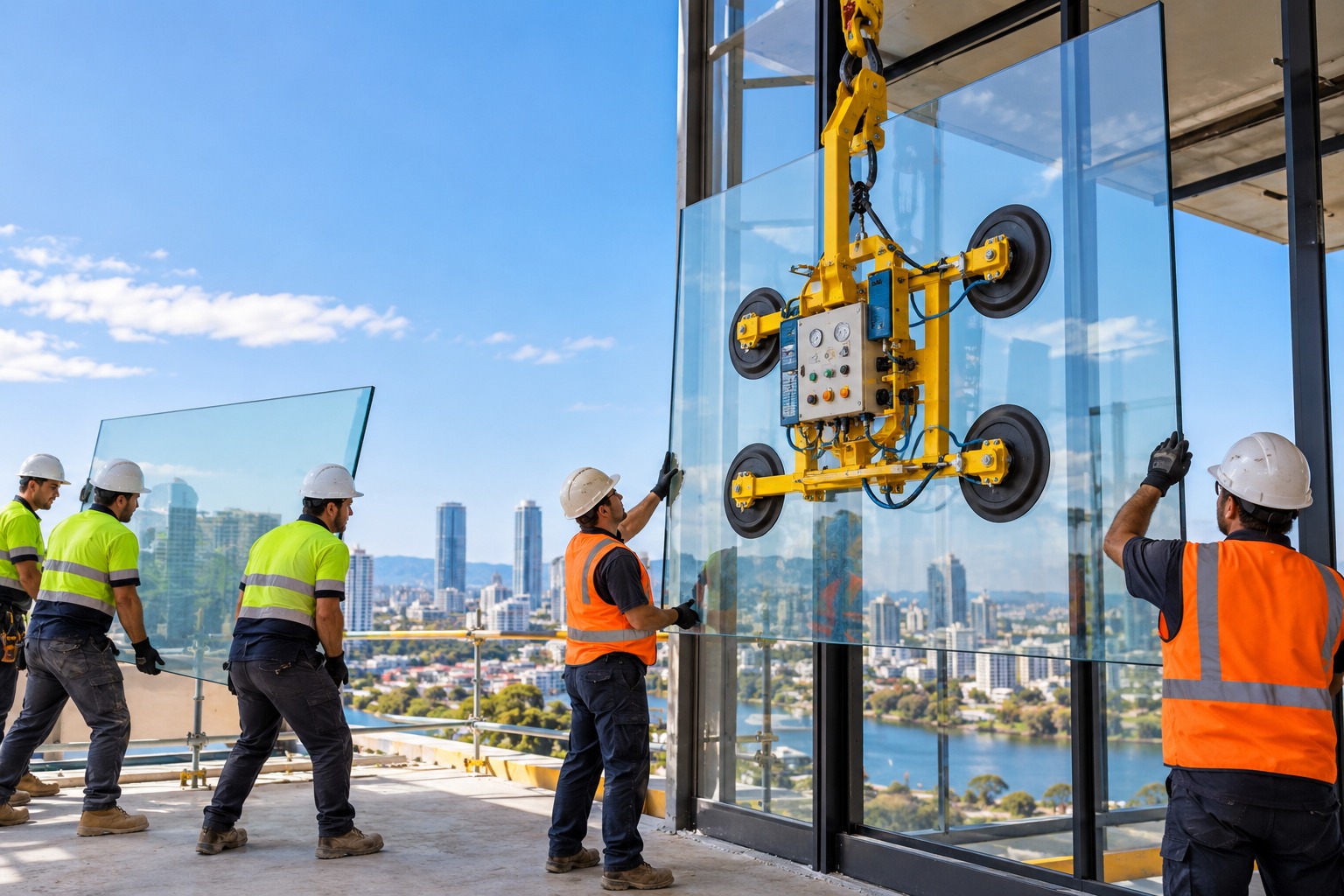
Handling large glass panels is a demanding task for construction companies, glaziers, manufacturers and installation teams across Australia. As glass sizes become larger and projects require faster installation, businesses need safer and more efficient ways to move, position and install glass.
This is where a glass vacuum lifter can provide a significant advantage over traditional manual glass handling.
A glass vacuum lifter uses controlled vacuum pressure to grip and support non-porous glass surfaces, allowing operators to lift and manoeuvre glass with mechanical assistance. Compared with manually carrying large or awkward glass panels, vacuum lifting equipment can reduce physical handling, improve positioning and help streamline workflows.
But is a vacuum lifter for glass always the better option? And how does it compare with manual glass handling in terms of safety, speed and efficiency?
Let's compare both methods and look at what Australian businesses should consider before choosing their glass handling equipment.
What Is a Glass Vacuum Lifter?
A glass vacuum lifter is a mechanical lifting device designed to grip glass using vacuum suction. Depending on the equipment configuration, the lifter can be used with cranes, jibs, forklifts or other lifting systems.
Modern vacuum glass lifters can be designed for different glass sizes, weights and applications. They can also be configured for specific movements such as lifting, tilting, rotating and positioning.
For businesses working with large glass panels, architectural glazing and other non-porous sheet materials, a vacuum lifter can provide a controlled alternative to relying entirely on manual handling.
Australian workplace guidance recognises vacuum-assisted lifters and glass panel lifters as examples of mechanical aids that can reduce the physical demands associated with manual tasks.
Manual Glass Handling: What Are the Challenges?
Manual glass handling may involve two or more workers carrying, positioning or supporting a glass panel.
While manual handling can be appropriate for some small or lightweight materials, the risks can increase as the size, weight, frequency or awkwardness of the load increases.
Glass presents additional challenges because it can be:
- Large and difficult to grip
- Heavy or awkward to manoeuvre
- Difficult to position accurately
- Vulnerable to damage during handling
- Capable of causing serious injury if it breaks
- Difficult to control in confined areas
- Physically demanding during repetitive installation work
Safe Work Australia identifies repetitive movement, sustained or awkward postures, high or sudden force and other physical demands as factors that can contribute to hazardous manual tasks and musculoskeletal disorders.
For Australian businesses, the objective should therefore not simply be to move glass faster. The handling process should be designed to reduce risk while improving productivity.
Glass Vacuum Lifters vs Manual Glass Handling: Safety Comparison
Safety is one of the biggest reasons businesses consider investing in glass lifting equipment.
Manual glass handling
When workers manually carry large glass panels, they may need to:
- Bend or twist while carrying the load
- Maintain awkward postures
- Apply significant physical force
- Coordinate movements with other workers
- Carry the panel over uneven or restricted areas
- Hold the glass while another worker positions it
These factors can contribute to manual task risks.
Safe Work Australia recommends identifying hazardous manual tasks, assessing the associated risks and implementing controls to eliminate or minimise those risks where reasonably practicable. Mechanical aids can be one way of reducing the physical demands of manual handling.
Glass vacuum lifters
A properly selected and operated vacuum lifter for glass can reduce the need for workers to physically support the full load.
Instead of several workers carrying a glass panel, the lifting equipment supports the load while operators control its movement.
This can help reduce:
- Manual lifting forces
- Awkward postures
- Repetitive physical handling
- Unnecessary carrying
- Coordination difficulties between multiple workers
However, vacuum lifting equipment does not eliminate the need for proper safety procedures. Operators still need appropriate training, equipment inspections, load assessment and adherence to the manufacturer's operating requirements.
The key difference is that a vacuum glass lifter can act as an engineering control that reduces the physical demands placed on workers.
Which Is Faster: Manual Handling or a Vacuum Glass Lifter?
Speed is another major consideration for construction and glazing businesses.
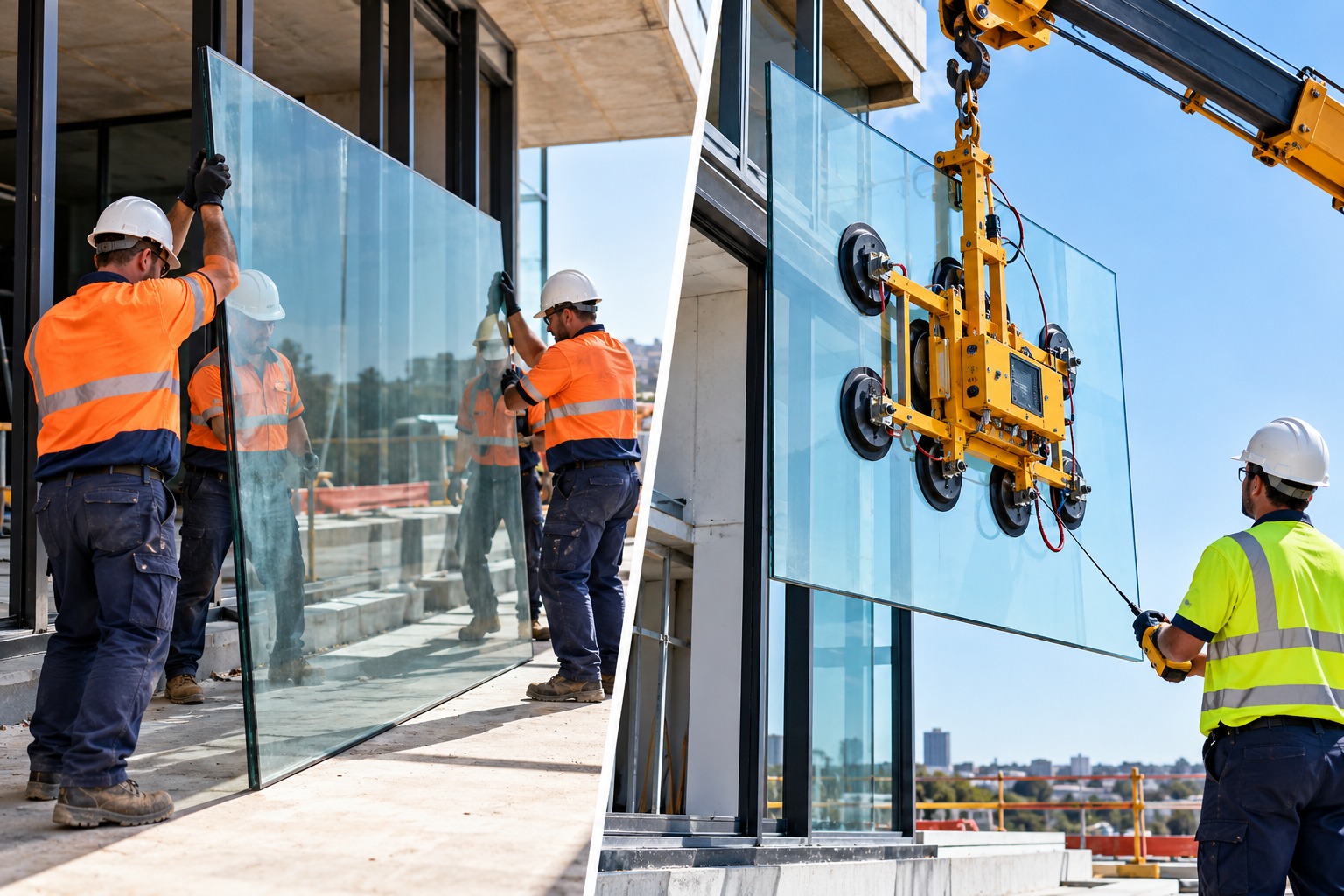
Manual handling often requires several workers to coordinate their movements. The team may need to:
- Pick up the glass.
- Carry it to the installation area.
- Reposition their grip.
- Align the panel.
- Hold it while adjustments are made.
- Repeat the process for the next panel.
As panel size and weight increase, this process can become increasingly difficult.
A glass vacuum lifter can simplify the workflow by mechanically supporting the glass during movement.
The equipment can allow operators to:
- Pick up large panels
- Move them into position
- Adjust the orientation
- Position the glass more precisely
- Reduce unnecessary manual carrying
The actual productivity improvement will depend on the glass size, site conditions, equipment configuration and operator experience. However, reducing the number of manual handling steps can create a more consistent workflow.
For projects involving repeated glass installation, even small time savings per panel can become significant across hundreds of panels.
Glass Vacuum Lifters and Installation Efficiency
Efficiency isn't only about how quickly a panel moves.
It also involves how easily the panel can be positioned accurately.
Large glass panels often need to be aligned carefully with frames, façades, doors, windows or architectural structures. Manual handling can make this difficult because workers are simultaneously supporting the weight and trying to achieve accurate positioning.
A vacuum glass lifter separates these two challenges. The lifting equipment supports the panel while operators focus on controlled movement and positioning.
This can be particularly useful for:
- Commercial glazing
- Architectural projects
- Large window installation
- Glass manufacturing
- Curtain wall installation
- Transport and handling
- Construction projects
- Stone and other non-porous materials
The right equipment can therefore help improve both handling consistency and productivity.
Can Vacuum Lifting Equipment Be Used for Materials Other Than Glass?
Yes.
Although a glass vacuum lifter is commonly associated with glazing and glass installation, vacuum lifting technology can also be used with suitable non-porous materials.
Depending on the equipment design and specifications, applications may include:
- Glass
- Stone
- Marble
- Steel
- Stainless steel
- Aluminium
- Panels
- Other suitable non-porous sheet materials
For example, VacLift's glass handling equipment is designed for glass, stone, steel, rubber and other non-porous sheet materials, with applications including glass manufacturing, glazing, architectural projects and stone fabrication.
The important consideration is always compatibility between the lifting equipment, surface condition, material characteristics, load weight and intended application.
How to Choose the Right Vacuum Lifter for Glass
Not every vacuum lifter is suitable for every glass handling application. Before purchasing glass lifting equipment, consider the following factors.
1. Glass Weight
Determine the maximum weight of the glass panels you need to lift. The equipment must have an appropriate rated capacity for the intended application.
2. Glass Dimensions
Large panels may require different vacuum pad configurations from smaller glass sheets. Consider both the width and length of the glass.
3. Surface Condition
Vacuum lifting relies on an effective seal between the vacuum pads and the material. The surface should be suitable for the equipment and free from conditions that could compromise the vacuum seal.
4. Required Movement
Do you only need to lift the glass vertically? Or do you need to tilt it, rotate it, move it horizontally, and position it accurately? The required movement should influence your equipment selection.
5. Lifting Environment
Consider where the equipment will operate (construction sites, factories, warehouses, glazing sites, manufacturing facilities). The available crane, forklift, jib or other lifting system will also influence the right configuration.
6. Power Source
Different vacuum lifters can use different power sources, including battery or compressed air systems. Your working environment and operational requirements should determine which configuration is appropriate.
Why Australian Businesses Are Moving Towards Mechanical Glass Handling
Across Australian construction and manufacturing environments, businesses need to manage workplace risks associated with manual tasks while maintaining productivity.
Safe Work Australia's guidance recommends considering ways to eliminate or minimise hazardous manual tasks and specifically identifies mechanical aids as a potential control measure.
This makes mechanical lifting equipment relevant not only for large construction projects but also for glass manufacturers, glazing contractors, window installers, fabrication businesses, building contractors, warehouses, and architectural contractors.
How can we move the glass safely, efficiently and consistently?
A vacuum lifting system can be part of that solution.
Is a Glass Vacuum Lifter Better Than Manual Handling?
For businesses regularly moving large, heavy or awkward glass panels, a glass vacuum lifter can offer important advantages over manual handling.
It can reduce the physical demands placed on workers, improve control during positioning and make repetitive glass handling more efficient.
However, the equipment should not be viewed as a simple replacement for all manual work. A safe glass handling process combines appropriate equipment with operator training, inspections, risk assessment and suitable workplace procedures.
The strongest business case usually exists where glass handling is heavy, repetitive, awkward or requires precise positioning.
For Australian businesses looking for vacuum lifting equipment, selecting equipment specifically designed around the application's material, weight, dimensions and movement requirements is essential.
Why Choose Australian-Made Vacuum Lifting Equipment?
Local engineering and manufacturing can provide advantages when equipment needs to be adapted to a specific application.
VacLift Australia manufactures vacuum lifting systems in Queensland and provides equipment for applications involving glass, steel, panels and other materials. Its glass handling system is designed for applications including glazing, glass manufacturing and architectural projects.
For Australian businesses, local access to engineering support, servicing and spare parts can also be valuable when lifting equipment is an important part of daily operations.
The company states that its vacuum lifters are manufactured and tested at its Queensland facility and that servicing is available across the Gold Coast, Brisbane and Sunshine Coast.
Final Takeaway: Vacuum Lifting vs Manual Glass Handling
When glass panels become larger, heavier and more difficult to manoeuvre, relying entirely on manual handling can create challenges for both safety and productivity.
A glass vacuum lifter provides mechanical assistance that can reduce physical handling, improve control and help create a more efficient workflow.
For Australian glazing, construction and manufacturing businesses, the right vacuum lifting equipment can be particularly valuable when glass handling is repetitive, heavy or requires precise positioning.
The best approach is not simply to choose the fastest lifting method. It is to select a system that matches the glass, application, workplace and lifting requirements while supporting a properly managed safety process.
If your business regularly handles large glass panels, reviewing your current handling process and comparing it with a purpose-designed vacuum lifter for glass can be a worthwhile first step toward improving safety, speed and efficiency.
Quick Comparison: Manual Handling vs Vacuum Lifting
| Factor | Manual Glass Handling | Glass Vacuum Lifter |
|---|---|---|
| Physical effort | High for large panels; heavy strain on workers | Reduced with mechanical assistance & ergonomic support |
| Number of workers | May require 3 to 6+ workers to carry awkward loads | Can reduce manual crew requirements down to 1-2 operators |
| Positioning & accuracy | Physically demanding, higher risk of misalignment | Controlled mechanical 360° rotation & 90° tilt positioning |
| Repetitive handling | Significantly increases cumulative physical strain & fatigue | Maintains consistent, effortless handling throughout full shifts |
| Large glass panels | Extremely difficult and hazardous to manoeuvre | Engineered specifically for oversized sheets & architectural panels |
| Workflow consistency | Depends heavily on team communication and physical endurance | Highly controlled, repeatable, and streamlined workflow |
| Safety management | Requires extensive manual handling controls & high risk of injury | Engineering control compliant with AS4991-2004 with dual vacuum circuits |
| Productivity | Slows progressively as panel size, weight, and fatigue increase | Substantially accelerates installation rate per panel |
The right solution will always depend on the specific application, equipment specifications and site conditions.
Frequently Asked Questions
What is a glass vacuum lifter?
A glass vacuum lifter is mechanical lifting equipment that uses vacuum suction to grip and move suitable non-porous glass surfaces. Depending on the setup, it connects to overhead cranes, mobile cranes, forklifts, or jibs, reducing the need for workers to manually carry and support heavy glass panels.
Are vacuum lifters safe for glass?
Yes, when correctly selected, inspected, and operated according to Australian standards (AS4991-2004) and manufacturer guidelines. VacLift units incorporate dual independent vacuum circuits, vacuum reserve tanks, non-return valves, and audible/visual low-vacuum alarms to ensure fail-safe operation.
What is the difference between a vacuum lifter and manual glass handling?
Manual glass handling requires workers to physically bear the entire weight and balance of the panel, creating significant musculoskeletal strain and drop hazards. A vacuum lifter uses mechanical assistance to hold and support 100% of the load weight, allowing operators to guide and position the glass with minimal physical effort.
Can a vacuum lifter handle large glass panels?
Yes. Many vacuum lifting systems are specifically engineered for oversized and architectural sheet materials. Custom pad configurations, extendable arms, and high-capacity suction pads allow handling of glass panels weighing from 250 kg up to several tonnes.
Can glass vacuum lifters be used for stone?
Yes. VacLift vacuum systems can handle suitable non-porous and semi-smooth stone, marble, granite, steel, aluminium, and composite panels. Always check equipment specifications and pad compound suitability for the specific surface texture.
Are vacuum glass lifters suitable for construction sites?
Yes. Battery-powered, self-contained vacuum lifters are extensively used on outdoor construction and glazing sites. They require no external trailing air hoses or power cables, offering total manoeuvrability for high-rise façade and curtain wall installation.
How do I choose the right vacuum lifter for glass?
Consider maximum glass weight, dimensions, surface texture, required movements (such as 90° hydraulic tilt or 360° continuous rotation), lifting host (crane, telehandler, or forklift), and operating environment. Our Australian engineering team can custom-design a lifter tailored to your exact application.
Does vacuum lifting eliminate manual handling risks?
Vacuum lifting acts as a powerful engineering control that dramatically reduces physical lifting forces and awkward postures, but it does not eliminate the need for general site safety procedures. Operators still need proper training, pre-use inspections, and adherence to safe operating practices.
Looking for a VacLift for Glass Handling?
Precision vacuum lifting equipment engineered for glass, stone, steel and non-porous sheet materials. Custom built to your specifications.